
Introduction
For decades, commercial, corporate and industrial audio design followed a familiar physical arrangement: a rack-mounted chassis with microphone and player inputs, amplifier feeds and a DSP at its centre. As audio over IP has matured, particularly Dante and AES67, the architecture of the audio processor or matrix has changed substantially.
The rear panels of two generations of processors reveal this transition. Traditional matrices carry numerous connectors for local audio wiring, whereas some newer devices have almost no conventional audio sockets and rely on network ports. Engineers and project owners now encounter two approaches whose boundaries continue to evolve.
Interactive comparison of two Ecler processor rear panels
Drag the handle or use the arrow keys.
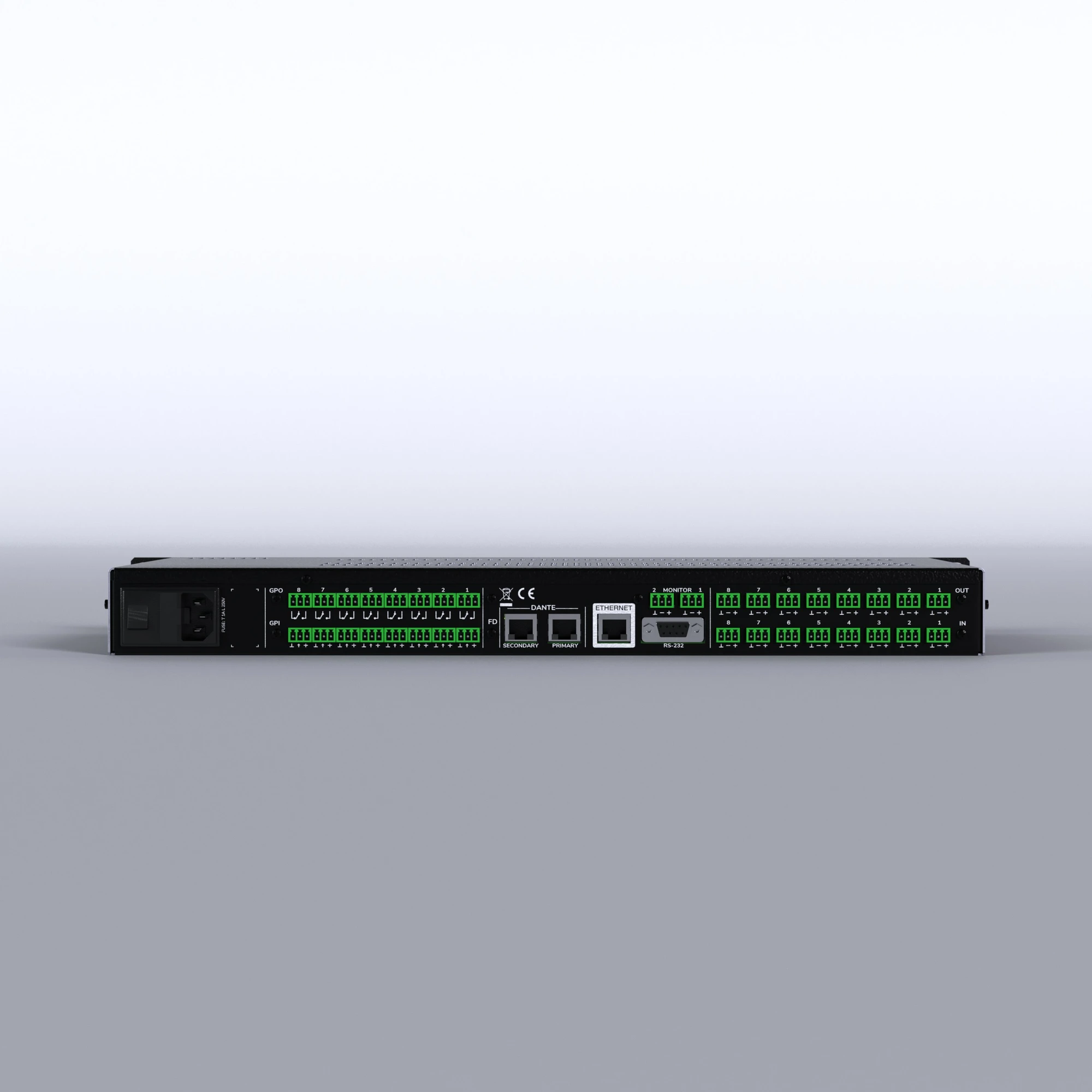
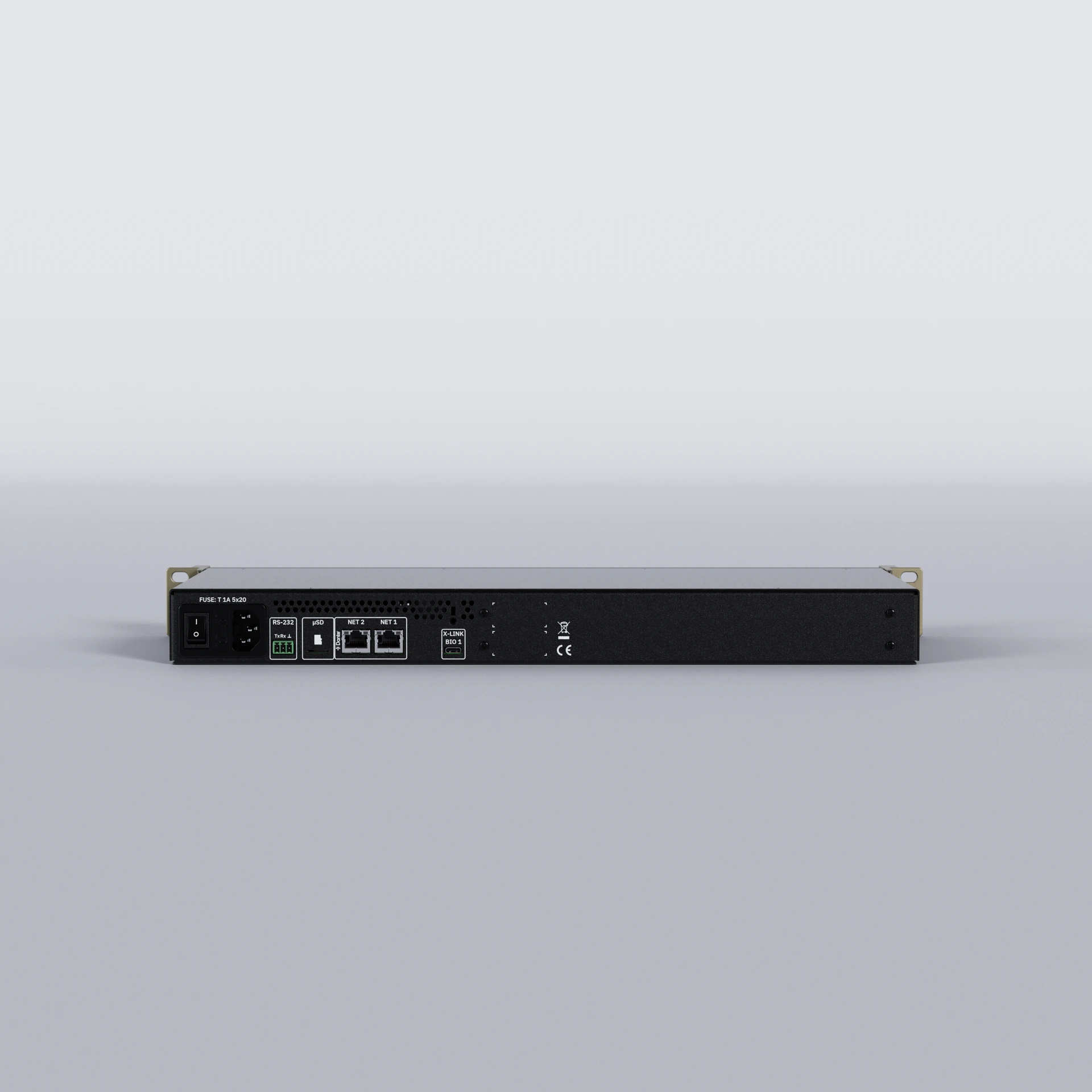
MIMO7272DN is shown on the right, with analogue I/O and Dante ports. VIVO-XØD32 is on the left, with 32 × 32 Dante/AES67 channels on NET 2 and a local X-LINK expansion port.
1. Two approaches to networked audio processing
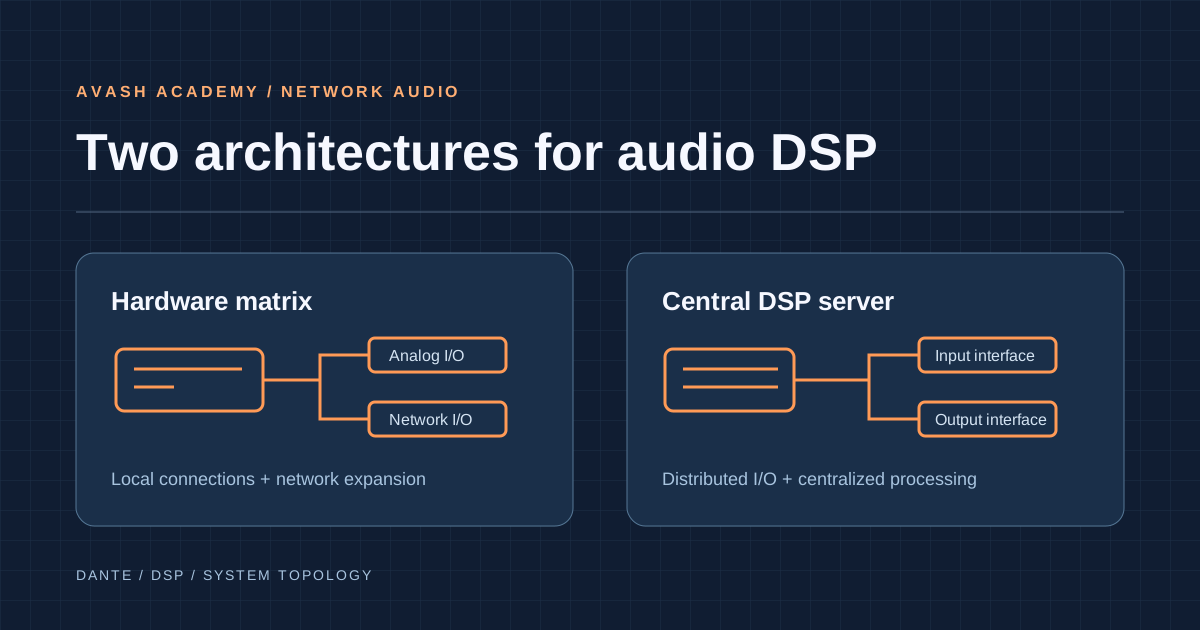
Dante-enabled systems can be grouped by their processing architecture and I/O arrangement. A. Dedicated processors with network expansion. In a scalable matrix such as Ecler MIMO7272DN, the core remains a dedicated audio device with analogue I/O on its chassis. It directly connects microphones, players and amplifiers in the central rack and also provides Dante Primary and Secondary ports. When additional floors or production buildings require more zones, the system can be extended with network interfaces, I/O expanders, paging stations and networked amplifiers, provided the core has sufficient processing capacity, channels and licences. In a factory paging system, this supports additional zones for production buildings and lines.
The design centres on dedicated audio processing in a standalone chassis. System reliability depends on design, installation and operating conditions.
B. Server-based architecture with centralised software management.
QSC is one of the established examples of this approach.
Its IT-oriented system architecture moves beyond the traditional view of an audio matrix as a collection of local connections.
Here, the central device functions as a powerful processing server. Many such devices have no conventional microphone inputs or analogue audio outputs on the rear panel, providing network, power and control connections instead.
The design consolidates audio, video and control processing in a central server and moves physical I/O to network endpoints throughout the building.
2. Why established processor manufacturers are moving towards network-only cores
An important recent development in the international market is the changing strategy of manufacturers long associated with conventional hardware processors.
Symetrix is one example. Engineers have known the brand for processors with extensive analogue connectivity. Products such as D100 demonstrate a move towards network-based processing for large systems, without conventional local audio I/O. BSS OMNI provides another example of networked processing. Biamp Tesira SERVER-IO can accommodate both Dante networking and local I/O cards.
The EclerPLEX ecosystem and VIVO-XØD32
Spanish manufacturer Ecler has taken its own approach to this transition. Building on the MIMO matrix family, EclerPLEX and VIVO-XØD32 introduce a networked host architecture. The Ø in the model name denotes the absence of analogue I/O on the chassis. This host matrix provides 32 Dante/AES67 network inputs and 32 outputs through NET 2. NET 1 carries control traffic, while NET 2 supports control and Dante/AES67. EclerPLEX project profiles and graphical end-user control panels support different operational requirements.
X-LINK provides a local expansion path. A core without analogue I/O needs a compatible interface for local audio connections. Ecler supplies an X-LINK port, labelled BIO 1, for direct connection of BIO I/O expansion units. These local connections do not consume the host’s 32 Dante network channels or require a network switch. The architecture combines network scalability with dedicated hardware and a separate local expansion bus.
3. Understanding a processor without conventional audio connections
Engineers and clients accustomed to connecting microphone and amplifier cables directly to green terminal blocks may initially ask where those devices connect, or what happens if the network fails. Three design changes explain the architecture. First, processing and physical connections can be located separately. The core can sit in a secure, temperature-controlled server room with backed-up power, while audio interfaces are placed close to equipment. Dante interfaces can serve remote floors, and BIO units connect to the host through the local X-LINK bus.
Avoiding long analogue cable runs. Instead of routing hundreds of metres of microphone cable back to a central rack, where electrical interference and signal degradation may become concerns, audio can be digitised near its source and transported digitally to the processing core.
Network redundancy. Devices such as MIMO7272DN, with Dante Primary and Secondary ports, can use two independent networks for redundant audio paths. On VIVO-XØD32, NET 2 is the only port carrying Dante/AES67 audio.
4. Which architecture delivers better sound quality?
Engineers and demanding clients often ask whether a server or network-host system sounds different from a conventional hardware matrix. A useful comparison separates the signal path into three areas.
| Criterion | Hardware matrix | Server-based core | What to assess |
|---|---|---|---|
| Input and output | Onboard connections and network interfaces | Typically separate interfaces close to the equipment | Noise, dynamic range and converter performance |
| Processing | Dedicated DSP with a defined device capacity | Processing and channel capacity determined by model and licence | Algorithms, configuration, capacity and acoustic echo cancellation |
| Latency | Depends on analogue or network paths, processing and buffers | Depends on network paths, processing and buffers | Measure end-to-end latency in the actual system design |
Where does sound quality actually come from?
Processing in a server does not inherently give audio a distinctive “computerised” sound, and a more expensive core does not automatically produce clearer sound at the loudspeakers.
An important factor in audible performance is the point at which audio enters and leaves the network, particularly the analogue-to-digital and digital-to-analogue conversion stages.
Manufacturers such as Ecler and Symetrix have extensive experience in microphone preamplifiers and audio conversion. Even an expensive processing core cannot compensate for an unsuitable or poor-performing output interface feeding the amplifier. Manufacturer-matched expansion devices, such as Ecler BIO and BOB interfaces, are one way to align I/O with the system. Final performance depends on the converter specifications and the configuration of each zone.
5. Practical topology — following the two signal paths
With MIMO7272DN, some central-rack I/O connects directly to the matrix and remote zones are added over the network. With VIVO-XØD32, BIO provides local analogue I/O through X-LINK, while NET 2 transports audio over Dante/AES67.
6. Choosing the architecture for your project
Selecting an analogue-I/O matrix such as MIMO, a new-generation hybrid host such as VIVO-XØD32, or a network processing server such as Symetrix D100 or a QSC platform depends on project scale, zone count, distances between floors and budget. When designing an industrial paging system, also assess the capacity of each signal path and the announcement requirements.
A complex licensed server platform can add unnecessary cost to some projects. In other large, mixed-use installations, a host platform such as EclerPLEX can provide the independent operational control that the project needs.
Article technical references
Does your project need an audio matrix or a central processing server?
Select the application, zone count and main project concern so the AVASH team can assess the architecture.