
Introduction
Any AV engineer who has designed and delivered large installations understands the constraints of traditional analogue distribution. A substantial part of the work involves managing the physical behaviour of copper cabling alongside the audio design.
Imagine distributing audio across several hectares of industrial buildings containing variable-frequency drives, three-phase power cables and strong electromagnetic fields. Increased line impedance, capacitive high-frequency roll-off on long cables, ground-potential differences that produce 50 Hz hum, and reduced signal-to-noise ratio are recurring design challenges.
The transition to audio over IP, or AoIP, involves more than replacing copper multicore cables with Ethernet or fibre. It changes signal architecture, distribution, processing and security. Drawing on installation experience, this article examines Dante from its network foundations to practical system operation, compares alternative technologies and describes its implementation at the 85,000 m² Depoint factory.
1. Earlier audio networks — CobraNet and the closed BLU link ecosystem
Before Australian company Audinate introduced Dante in 2006, the AV industry was already seeking digital distribution. CobraNet and, later, EtherSound were early approaches to the problem.
First-generation Layer 2 constraints
CobraNet operates at the data-link layer, Layer 2 of the OSI model. Its audio transport uses MAC-level addressing rather than routable IP packets. This has practical implications for system designers.
Non-routable audio transport. CobraNet audio cannot simply pass through IP routers between subnets. Its audio network must be planned as a Layer 2 domain, often separately from the organisation’s routed IT infrastructure.
Latency. A commonly quoted CobraNet latency is 5.33 ms, which can be a significant constraint in live applications or systems with strict acoustic timing requirements.
Bandwidth. Fast Ethernet operation at 100 Mbps limits the channel capacity available for uncompressed audio.
Proprietary transport — BSS BLU link
Manufacturers also developed transports for communication within their own product ecosystems. BLU link, from Harman’s BSS Audio, is a notable example with a purpose-built connection architecture.
BLU link is a straightforward way to connect devices within and between equipment racks. It supports up to 256 channels at 48 kHz or 128 at 96 kHz over suitable Cat5e/Cat6 links, with very low device-to-device latency. Its topology is a point-to-point digital audio bus. Devices are daisy-chained, and the final output can return to the first input to form a redundant ring.
Standard Ethernet switches do not forward BLU link audio. Two racks separated by 500 metres cannot simply exchange BLU link through the building LAN. They require a dedicated, compatible connection or media-conversion arrangement.
Vendor ecosystem. BLU link is associated with compatible Harman products such as BSS processors, Crown amplifiers and Soundcraft consoles. This can constrain an integration project that needs conference microphones, matrices or specialist loudspeakers from several manufacturers.
2. Dante architecture — what IP networking changes
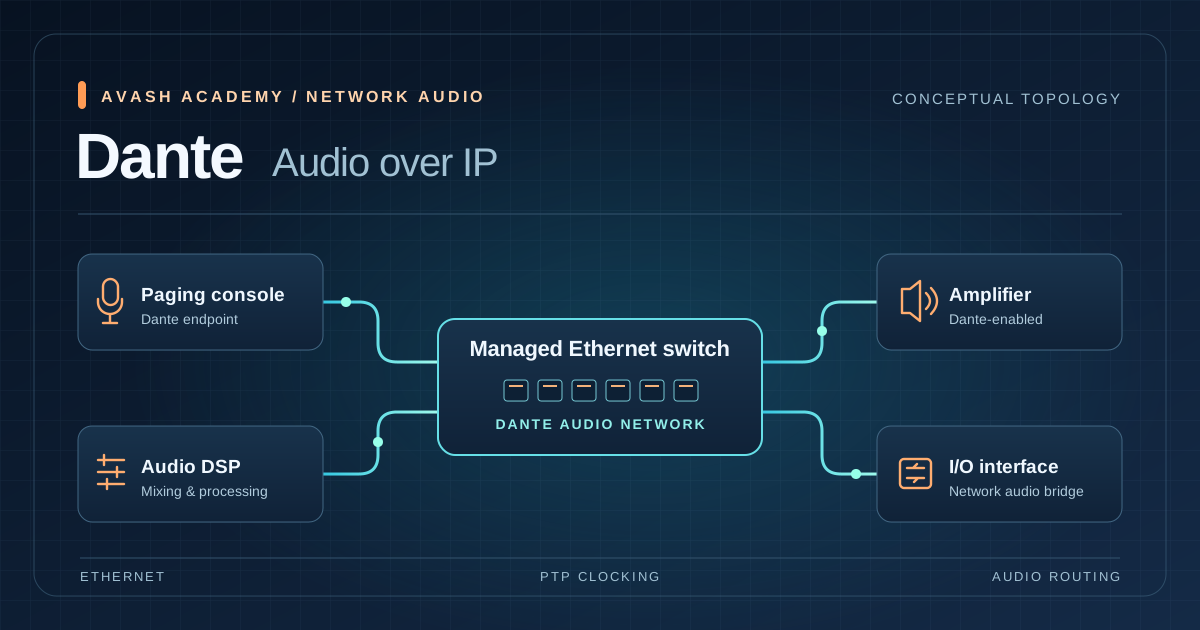
Dante, Digital Audio Network Through Ethernet, takes an IT-oriented approach to audio transport by using established networking infrastructure.
Its audio transport uses standard IP networking, specifically UDP/IP. A Dante design can use suitably configured Gigabit and 10-Gigabit switches, VLANs, routers and fibre links. The central engineering requirements are clock synchronisation, traffic prioritisation and bandwidth management. Routed operation requires the appropriate system support and network configuration.
A. Synchronisation with IEEE 1588 Precision Time Protocol
Digital audio transmitters and receivers must agree on sample timing. Inadequate clock synchronisation can lead to clicks, dropped samples and interruptions.
Dante uses Precision Time Protocol. Conventional Dante clocking uses PTPv1, while AES67 operation uses PTPv2. A leader clock is elected or selected, and compatible devices synchronise their internal clocks to it with sub-microsecond accuracy. This coordinates digital sample timing across the network. Acoustic phase at a listening position still depends on processing, loudspeakers and physical propagation.
B. Stream capacity, sample rates and deterministic latency
Dante transports uncompressed PCM audio rather than applying lossy or lossless audio coding. Compatible devices offer 24- or 32-bit operation and sample rates ranging from 44.1 kHz to 192 kHz.
Some Gigabit interfaces support up to 512 receive and 512 transmit channels at 48 kHz/24-bit. At 192 kHz, an equivalent implementation may provide 128 × 128 channels. These are implementation examples, not capacities guaranteed for every Dante port.
Receiver latency is configurable within the limits of the device and topology. Available settings can range from 150 µs on certain high-performance devices to 1 ms for suitable multi-switch networks and 5 ms for larger installations.
Channel capacity, sample rate and minimum latency depend on the device and network. A 150 µs receiver-buffer setting on a compatible device does not describe the latency of the complete audio system.
C. Quality of service — sharing a network with other traffic
IT managers frequently ask whether audio will conflict with CCTV, ERP servers or large file transfers on the factory network.
DiffServ quality of service uses DSCP markings in the IP header. Time-critical PTPv1 clock packets use DSCP 56, or CS7, so a correctly configured switch can prioritise them.
Audio payload packets use DSCP 46, or EF.
Control traffic and ordinary IT data are normally assigned lower priorities.
A correctly configured QoS-capable switch places priority traffic in the appropriate egress queues. Lower-priority packets may wait while time-sensitive traffic is served. Reliable operation also depends on available bandwidth, queue configuration and network topology. Priority marking alone does not guarantee interruption-free audio.
D. Stream management — unicast and multicast
Dante Controller provides routing and diagnostic functions. Audio subscriptions normally create unicast flows, often carrying up to four channels per flow on typical implementations. If one source must feed paging or BGM to 20 amplifiers, separate unicast flows increase the transmitter’s bandwidth and flow usage.
A multicast flow allows the transmitter to send one stream that the network distributes to several receivers. With correctly configured IGMP snooping and multicast management, switches forward the stream to the ports that need it.
3. Cybersecurity and enterprise AV networks
Connecting audio to an organisation’s IP infrastructure introduces access-control requirements. On an unmanaged Dante network, a connected user with Dante Controller may be able to view or change routing, subject to device controls. That is a significant operational concern in a factory, airport or conference venue.
Network segmentation is a first layer of protection. A dedicated VLAN, appropriate subnets and access-control lists on managed switches can restrict access to audio devices.
Dante Domain Manager adds domain-based administration, user authentication, role-based permissions and audit logging. Supported directory integration, including Active Directory or LDAP, helps organisations manage access. DDM also supports appropriately designed Dante systems spanning multiple subnets. Features and security mechanisms depend on the deployed software and device versions.
Media encryption. Compatible newer Dante implementations can provide AES-256 encryption of supported audio or video streams to protect content between endpoints.
Media encryption depends on device model, firmware and the policies supported by the participating devices.
4. Dante compared with AES67, AVB/Milan and BLU link
The following table compares the engineering characteristics of four audio transport approaches.
| Technical parameter | ||||
|---|---|---|---|---|
| OSI layer | Layer 3 — UDP/IP | Layer 3 — RTP/UDP/IP | Layer 2 | Proprietary digital bus |
| Network switches | Standard Ethernet, configured for the application | Standard Ethernet, configured for the application | AVB-capable switches | Direct device-to-device links |
| Resolution and sample rate | Up to 32-bit/192 kHz on compatible devices | 24-bit/48 kHz in the baseline profile | Depends on profile and device | 48 or 96 kHz |
| Channel capacity | Up to 512 × 512 on some Gigabit interfaces at 48 kHz | Implementation-dependent | Implementation-dependent | 256 at 48 kHz or 128 at 96 kHz |
| Clocking | Bus clock | |||
| Discovery and control | Requires additional mechanisms | AVDECC discovery and control | Within the BSS/Harman ecosystem | |
| Redundancy | Primary and Secondary networks on compatible devices | Implementation-dependent | Redundancy on compatible Milan devices | Direct ring |
| Ecosystem | Multi-manufacturer products | Interoperability standard | AVB/Milan-compatible equipment | Compatible Harman products |
AES67 and Dante — alternatives or complementary technologies?
AES67 is an interoperability standard rather than a complete product or management system. It enables compatible implementations, including Dante, Q-LAN, Livewire and RAVENNA, to exchange audio streams. It does not itself supply the complete discovery, naming, security and monitoring environment of an audio ecosystem. Supported Dante devices can enable AES67 transport while retaining their Dante management facilities, subject to device capabilities and configuration.
5. Return on investment and total cost of ownership
A Dante-equipped device may initially cost more than an analogue equivalent. The source article uses an illustrative 15–20% equipment premium. A project assessment should consider total cost of ownership and installation, rather than hardware price alone. In a 30-zone system with many microphones, dedicated shielded audio cables, segregated conduit, trays and installation labour can be substantial. Suitable Ethernet or fibre infrastructure may carry many audio signals together and may already exist on site.
Expansion. If a new office building or production line is added to the factory paging system, an analogue design may require new central-to-building cable routes. A Dante design can add a compatible expander or amplifier at a suitable local switch, then configure the new zone in software, provided infrastructure and processing capacity are available.
Reducing analogue interfaces. Networked distribution can reduce the need for DI boxes, transformer isolators and line drivers, along with the labour required to investigate induced interference on long analogue paths.
6. Case study — Dante at the 85,000 m² Depoint industrial site
Engineering principles gain practical value when tested on site. AVASH designed and delivered integrated audio, industrial paging and BGM over Dante at the Depoint factory, Gol-Asay Sarma, in Eyvanaki Industrial Estate.
Project engineering challenges
The 85,000 m² industrial site comprised 18 separate physical areas, including production buildings, warehouses, offices, external areas and ancillary buildings. It required 28 independently controlled audio zones.
Long distances between buildings made extensive analogue distribution particularly challenging because of signal loss and industrial interference.
The acoustic conditions varied substantially, from high and changing ambient noise on production lines to relatively quiet office spaces.
The routing requirements included live paging from multiple consoles to selected zones, recorded safety and scheduled messages, and independent background music in different areas.
AVASH system architecture and implementation
The design used distributed Dante transport with Ecler hardware. An Ecler MIMO7272DN in the central server room provided the main processing and routing. Its 64 × 64 Dante capacity supported source signals, paging consoles and zone outputs, with per-zone processing such as parametric EQ, compression, limiting and level adjustment.
Fibre and Ethernet distribution. Local edge racks were installed at strategic positions. The central rack and local racks were connected through fibre infrastructure and Gigabit switches configured for the required VLAN and QoS behaviour.
Network interfaces and paging consoles. Remote locations used Dante expanders such as Ecler DN44BOB and touchscreen PAGENETDN paging consoles. A PoE network connection linked each compatible console to a nearby switch and carried its digital audio to the central matrix.
The final acoustic layer. Audio delivered to each local rack was converted and fed to multi-channel amplification. Loudspeaker selection reflected reverberation time, RT60, and required sound pressure level. The design combined industrial sound projectors such as eMSP50Ti in production areas with eCS803 columns and IC6 ceiling loudspeakers for appropriate office and ancillary spaces.
Project outcome
The system entered operation following a six-month programme. The reported outcome was clear communication in challenging production areas, avoidance of the long analogue paths responsible for hum and electromagnetic interference, and custom graphical panels for practical control of all 28 zones across the site.
Dante architecture at the 85,000 m² Depoint factory
Designed and installed by AVASH · 18 physical areas · 28 control zones
1. Server room and central processing
- Networked paging consoleEcler PAGENETDN · PoE
- Central digital matrixEcler MIMO7272DN · Dante 64 × 64
- Managed core switchGigabit Ethernet · VLAN · QoS
2 and 3. Inter-building transport and local distribution
- Inter-rack transportFiber Optic Ethernet
- Local racks and audio interfacesEcler DN44BOB · Dante
- Amplification and loudspeaker lineseMSP50Ti · eCS803 · IC6
Logical signal path from paging console to loudspeaker. Dante audio typically uses DSCP 46 priority, and PTP synchronises clocks between network devices. Amplifier outputs feed the loudspeaker circuits serving each zone.
Closing perspective
Dante changes the AV designer’s task from managing extensive dedicated copper signal routes to planning a networked system architecture. IP transport adds flexibility in distribution, processing and control, within the capacities and requirements of the chosen platform.
Whether designing a luxury showroom or a large industrial communications system, AVASH applies networking, acoustics and system integration to a practical goal: sound that is clearly heard and a system that is straightforward to operate.
Frequently asked questions
What is the main difference between Dante and BLU link?
Dante transports audio over IP and can operate across a suitably designed and configured Ethernet network. BLU link is a proprietary Harman audio bus that directly connects compatible devices and can form a closed ring for redundancy.
What audio quality and channel capacity does Dante support?
Dante transports uncompressed PCM audio. Some Gigabit interfaces support up to 512 input and 512 output channels at 48 kHz, and some devices support 32-bit audio and 192 kHz sampling. Capacity, resolution and minimum latency depend on the device and network configuration.
Article technical references
Which sound system suits your space?
Select the playback objective, environment and design priority so the AVASH team can assess suitable options.