
Start with the site plan
Choosing between 100 V distribution and networked audio is a significant infrastructure decision in a new factory or retrofit. Site size, independent zones, existing cabling, required output and expansion plans matter more than the technology name.
First establish who pages which areas, the source and level required in each zone, and the operational impact of a local failure. Then select transport, amplification and transducer circuits.
100 V distribution over copper
In 70 V or 100 V constant-voltage distribution, transformer-equipped transducers connect in parallel to a compatible amplifier output, using suitable taps. For equal power, higher voltage reduces current and can make losses more manageable along long cable routes.
Low-impedance circuits do not have a universal maximum cable length either: power, conductor area, impedance and acceptable loss determine the design. A 100 V circuit still needs tap-load, channel-capacity and cable-loss calculations.
See the 100 V line-load guide and 100 V amplifier data sheets for the next design checks.
- Economical distribution to multiple passive transducers in a zone.
- Zoning follows output channels, physical circuits or specified switching equipment.
- Separating two groups on one shared circuit requires independent routing/outputs or suitable local control.
Dante and AoIP transport between network locations
Audio over IP transports audio over an IP network. Dante is one implementation, carrying multichannel digital audio with low, configured latency over a compatible network. Latency is not zero; device capabilities, network hops and configuration must suit the design.
Fibre links between buildings can extend reach and provide electrical isolation along the communication path. Specify fibre and transceiver type, link distance, switching, capacity, clocking and redundancy. An available network outlet alone does not establish infrastructure readiness.
Software routing increases flexibility, but practical zoning also depends on independent outputs and endpoint capabilities. Software cannot independently control two passive transducers on a shared output without suitable hardware.
Compare three approaches before procurement
| Criterion | Central 100 V | IP endpoints | Network + 100 V hybrid |
|---|---|---|---|
| Between buildings | Copper circuits; loss and protection review | Compatible copper or fibre network | Fibre/network to local racks |
| At the transducer | Typically transformer/passive components | Active electronics with local power or PoE | Passive transducer; local-rack amplification |
| Zone control | Channels, circuits or switching | Endpoint capabilities and network routing | Network routing plus independent local outputs |
| Expansion | Review cables and output capacity | Review network, power and model licensing | Expand network, racks and local circuits |
| Operation and maintenance | Simple distribution; central dependencies | Network and endpoint-power management | Network and local-rack environment management |
Hybrid architecture: network transport and local 100 V circuits
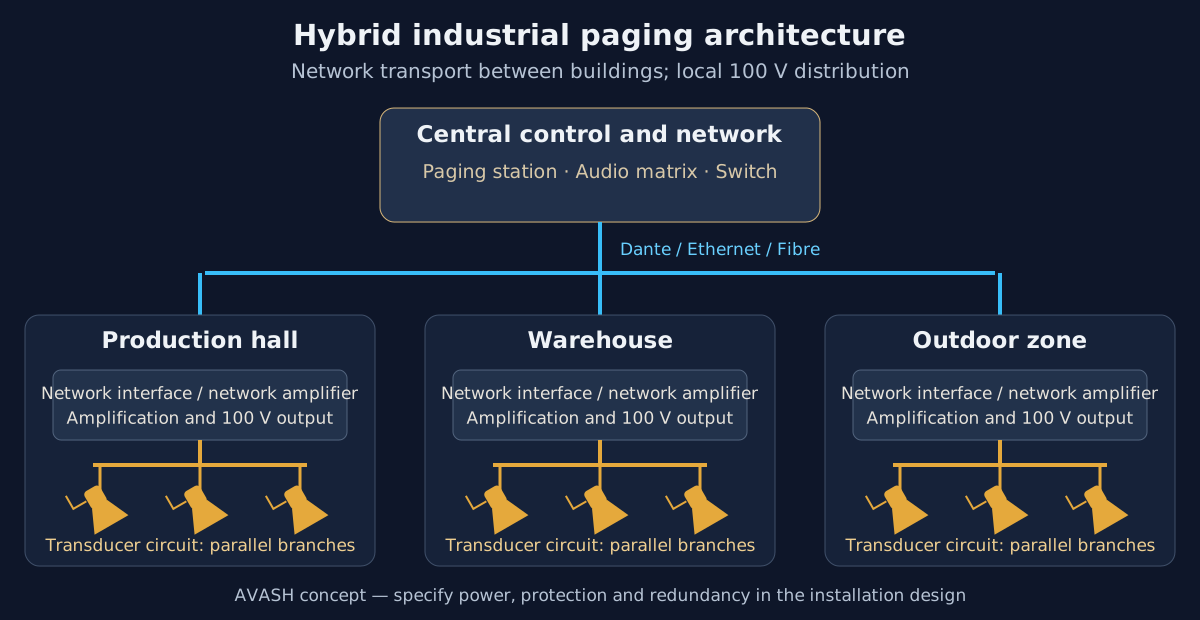
In a hybrid design, paging stations and the audio matrix connect to the network. Audio travels over copper or fibre to a local hall rack. A network interface or network-enabled amplifier feeds local distribution, with transformer transducers wired in parallel to the amplifier output.
This approach can combine multizone control and inter-building expansion with local passive distribution. Rack power and ventilation, maintenance access, circuit protection and behaviour during power or network failures remain integral design requirements.
Explore audio matrices, network paging stations and distribution amplifiers in the AVASH technical library.
IP or passive endpoints: review the environment
Suitably rated industrial IP and PoE equipment can be a valid choice. Any model lacking the necessary temperature, dust or moisture suitability is inappropriate regardless of transport technology. Compare switch cost, PoE budget, cabling and service access with local racks and 100 V distribution.
Operational paging and emergency voice alarm
GPIO or network commands can support message priority and music override in a compatible system. A fire-panel connection alone does not establish compliance as a voice alarm or evacuation system. Record the applicable project and authority requirements for circuit supervision, backup power, priorities, approved equipment and acceptance testing.
Prepare the architecture brief
Choose infrastructure alongside acoustic performance. The paging intelligibility and placement guide explains why advanced networking still needs suitable coverage and room-acoustic design.
- Site plan, building separations and existing copper/fibre routes.
- Zones, sources and operator access levels.
- Noise, environmental conditions and zone output needs.
- Rack/network capacity, backup power, expansion and emergency requirements.