
When flush mounting is not suitable
In an exposed gallery ceiling, on seating-area columns or on a restaurant terrace, mounting and exposure can matter more than driver size. Selection should follow listening geometry and architectural intent.
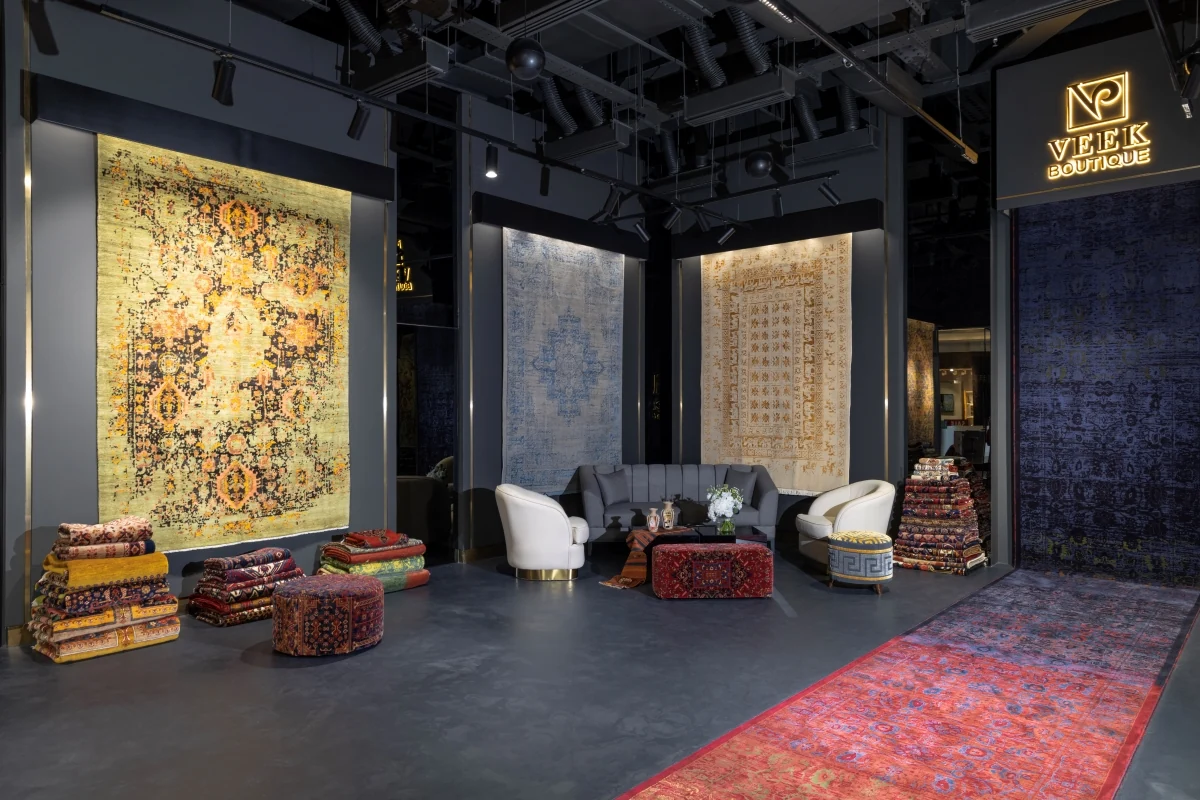
At Veek Boutique, AVASH’s project narrative emphasises coordination between pendant transducers, the dark ceiling and lighting rails. A different room and ceiling may require a different solution.
Three mounting forms, three design questions
eUC106 is designed for pendant installation. Lowering the source can reduce listener distance, subject to suspension safety, clearance and lighting coordination.
With AMBIT-16 and eMOTUS5OD, bracket aiming and audience coverage matter. Do not copy a mounting height from a project photo; coordinate seating, obstructions and circulation.
Compare reference specifications
The table follows the linked official data sheets. The 100 V taps are listed from high to low and are separate from the 8 Ω mode.
| Criterion | eUC106 | AMBIT-16 | eMOTUS5OD |
|---|---|---|---|
| Mounting | Pendant | Surface mount | Outdoor surface mount |
| 8 Ω RMS power | 40 W | 50 W | 40 W |
| 100 V taps, W | 32 / 16 / 8 / 4 | 30 / 15 / 7.5 / 5 | 30 / 15 / 7.5 / 3.75 |
| Nominal H × V angle | 151° × 151° | 143° × 140° | 150° × 150° |
| Ingress rating | IPX4 | IP54 | IP65 |
Ingress ratings have limits
Read ingress protection alongside mounting instructions, connector protection and orientation. IP65 does not mean immersion-proof or suitable for every cleaning method. Coastal, corrosive and directly exposed locations require a separate installation review.
The nominal angle is not an all-frequency coverage map. Review available frequency-specific data in the calculator and avoid treating unverified values as laboratory measurements.
What do 3 and 6 dB of headroom mean?
Under equal conditions, doubling power gives about 3 dB and quadrupling it about 6 dB. This ratio explains the arithmetic; it does not determine amplifier selection or limiter settings by itself.
In the AVASH power tool, a 90 dB sensitivity at 1 W / 1 m, a 90 dB target and a 10 m distance give a theoretical 100 W. Adding 6 dB headroom increases that estimate to about 398.1 W.
This does not permit applying 398 W to a 40 W transducer. When the requirement exceeds device limits, reconsider source distance, count, placement, model or target level. Limiters and thermal, mechanical and impedance limits still apply.
P = 10^((Target + Headroom − Sensitivity + 20 log₁₀(distance)) / 10)Make the project decision
Define mounting and exposure first, then estimate layout and required level. On a 100 V line, check tap load and reserve. On a low-impedance circuit, match channel power and protection to the selected model.